Australia, Northern Territory

Magic Kakadu

After a few days of hiking and kayaking up and down Katherine Gorge, I headed a bit north to spend a few days in Kakadu National Park. Kakadu is a UNESCO World Heritage Site, as is Shark Bay (around Denham and Monkey Mia in Western Australia) and Uluru (or Ayer’s Rock, where I will be heading next). I have to say that I was a bit cynical about the place when I first arrived, but it has turned out to be one of the coolest national parks I’ve ever been to. It is absolutely brimming with wildlife.

Visiting Kakadu was like taking a step back in time, thousands of years, long before humans infested the planet. I hesitantly did another crocodile tour through a wetlands area at a leprechaun-like ranger’s insistence at the gate. This time I did the cruise at dawn (whereas before I did it at dusk), and it was an absolutely magic experience. There were thousands of very active exotic birds singing and flying all over the place in flocks. We saw about five crocodiles lurking just below the surface of the water keeping warm in the cool morning air. There were beautiful (and harmless) snakes hanging off of trees. There were jumping fish, and wild horses (brumbies) and water buffalo in the distance, and much more. All this could be seen within meters of leaving the dock. It was especially beautiful with the thick morning fog lingering over the open water areas. I’ve never seen anything like it in my life. What you saw looked like one of those natural history museum depictions showing every kind of wild animal illustrated together from a specific environment, altogether in one painting, purely for informational purposes. But this was the real thing and it was all taking place before your very eyes.

This morning I did a walk through a rain forest area way up north (about as far north as you can drive in Australia on paved roads). I saw hundreds more bats, or “flying foxes” as they call them here, and also plenty more exotic birds and rock wallabies. I also stopped at another wetlands area on the way out of the park this morning and I felt I could have just sat there all day watching all the activity. There were continual flocks of birds hunting and flying back and forth. It’s amazing to think that it was only the 80’s when we stopped calling them “swamps” and filling them in.

In addition to all the wildlife, the whole area is very rich in Aboriginal culture. In fact, the whole park borders an “Arnhem Land” area to its north that is off limits to non-aboriginals without special permission. There were a wide range of Aboriginal rock paintings in caves around Kakadu National Park that were believed to be thousands of years old (as some of the paintings depict long-extinct animals).

The camping was great, with really nice personalized sites and access to hot showers. It’s a bit post peak at the moment, so there was plenty of space to spread out in. The only problem with the area was the heat and bugs (flies all day, mosquitoes all night). It was very hot and dry there, but every river you came across was accompanied by large crocodile warning signs.

Overall I feel like I’ve really been rushing this trip. I can see why most people take six months to do it. I could have easily spent at least a week in Kakadu and more time in places like Kununurra and Gregory National Park.

I’ve now arrived in Darwin, which ain’t much to write home about. It’s probably the size of Allentown or Lancaster, PA. At least I was able to get myself a nice Chinese meal this evening. It is their “dry” season here at the moment, but it sure feels hot and humid to me this time of year. It monsoons up here at “The Top End” all summer long. It is a bit cooler and breezier than Kakadu National Park was, anyway. Darwin is surrounded by beautiful ocean, but I’ve been advised not to swim in it because of saltwater crocodiles and killer box-jellyfish (even though this is their off season). It’s seems crazy with the heat. People up here say “I won’t swim in it unless it smells like chlorine.” It does seem as though everyone has a pool.

Darwin was practically obliterated on a few occasions — once due to Japanese bombing in World War II, and another time due to a big nasty cyclone in the seventies. I will probably check out all that historic stuff tomorrow. I will stay here two nights before making a beeline for Uluru (about 2 or 3 days drive south of here) cause my time is running out.

Australia, Northern Territory

Kakadu & Darwin Bound…

So I’m off into the wilderness again. Kakadu National Park, anyway. For a few nights of camping. Then I will check out Darwin and have to start peddling home to Perth as fast as I can.

The Katherine Gorge was lots of fun. There were some rough hikes down steep drops into the gorge, but you always had the option of a refreshing swim when you got there. Even though there were crocs around, the National Park people said it was safe for swimming if you followed a few guidelines and stayed clear of a few areas. Freshies, you see. I spent this morning kayaking up and down the river and taking lots of swims. It’s very hot and the sky is a very deep blue (like Perth in January)

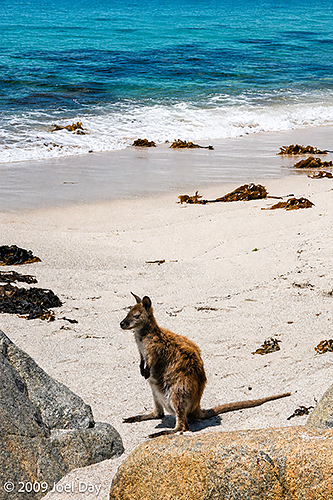
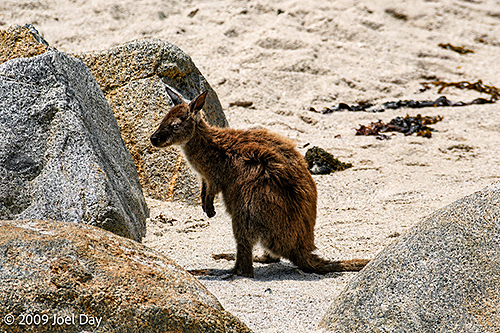
As for wildlife, the wallabies at this place were all over the place. And way too tame. There are so many wallabies here that have been fed, unfortunately, by tourists, that they actually come and harrass you at your camp site. They come right up to you and beg for food while you are eating. At least they appeared to be, but maybe that had something to do with there normal stance as wallabies. The rangers warn you not to feed them, but they can get very aggressive. I was eating a banana at one point and threw the peel on the ground with the intension of picking it up when I was finished. A few wallabies in the area started twitching their noses when they cought a wiff of the fruit, and slowly started hopping towards me. I immediately put my foot with my big hiking boot on top of the peel, but one of the wallabies grabbed at a scrap of it that I failed to cover. He started angrily pulling on it in a tug-of-war with me until I finally gave up and just let him have it. He sat there stripping off thin little slices of the peel, eating it slowly while I sat just a few feet from him.

And then last night I could have sworn I saw a bunch of bats flying around. Sure enough, this morning I found hundreds of fruit bats hanging off a big tree in our campground, making a lot of noise and grooming themselves. It was an amazing sight.

Australia, Northern Territory

from Katherine, Northern Territory…

I’ve now made my way to Katherine, Northern Territory, where I scored a sweet little camping spot in the Nitmiluk National Park (which is home to the famous Katherine Gorge). I will probably stay here a few nights and then start making my way up to Darwin via Kakadu National Park.

The drive from Halls Creek in Western Australia up through Kununurra (where I camped for a few nights) and into Katherine has been really spectacular. I did a wildlife cruise 43 kms down the Victoria River from Timber Creek, Northern Territory last night before camping in town. I will fill you in on the details in my Wildlife post.

Australia, Northern Territory

The Wildlife…

Travelling around Australia has been very interesting because of the continual and gradual transitions in the wildlife. Not only do you notice the obvious changes in vegetation as you move from one climatic zone to another, the animals continually change as well.

One of the coolest changes I always notice is the birds singing before sunrise every morning. Every time you drive for 3-4 hours and camp somewhere new, you notice that there are always new birds in the area singing different tunes. Some of them are really beautiful and sing complicated arrangements that vary, but always seem to return to a common refrain. I think the birds singing in the morning was one of the first things that hit me when I first visited Australia in 1986. That first morning, you really knew you were somewhere completely different from home.

Other transitions you notice are with things like massive termite mounds, that are all over the place up here. I started noticing them around Coral Bay, but they’ve been everywhere ever since.

The Kangaroos vary as well. There is a smaller version known as a wallaby that you find up here in the north, but they are also much more plentiful. I’ve seen hundreds of Kangaroos and wallabies from around the time I left Port Hedland.

One of my coolest experiences with wallabies was when I camped next to Mirima National Park in Western Australia (outside of Kununurra) a few nights ago. Around 1:30 in the morning I was awoken by somethings that sounded like they were munching on the grass next to my tent. Being in the new area I wasn’t quite sure whether it was a lizard or what, but I was soon able to peek out of a crack in the screen of my tent that showed 3-4 little 2 ft high wallabies nibbling on the grass just outside of my tent only a few feet away. They were there for about an hour. I thought it was pretty cool. I must have plunked my tent down right in their favorite grazing patch under a gum tree.

When I was in Karijini National Park I didn’t get that kind of interaction with any wildlife — but I was warned to watch out for dingos. I was told they had a fetish for shoes and that I should be careful not to leave my shoes outside of the tent at night.

Well I never saw any Dingos at Karijini, but I did see one for the first time today as I was driving from Timber Creek to Katherine here in the Northern Territory. I was driving through the Gregory National Park when one came running out of the tall grass to start chasing my car — just like a dog. I immediately slowed down to a stop to try and get its picture, but it ran off across the road.

Last night was especially interesting on the wildlife front. I was getting a bit sick of driving and arrived in Timber Creek, the only town between Kununurra, W.A. and Katherine, N.T. About the only thing to do in Timber Creek was take a wildlife cruise down the Victoria River 45 km towards the Joseph Boneparte Gulf. It was supposed to be chock full of crocs, with an estimated 500 in the 45 kms of pure wilderness. I thought it sounded much more interesting than the numerous enclosed crocodile parks you stumble across, where you only see them in captivity and can watch them eat slabs of chicken.

The cruise was quite good, spanning about four hours at sunset — which made for nice picture taking. We ended up seeing lots of eagles, jumping fish, kangaroos, and about four crocodiles sunning themselves on the banks of the river. They eat mostly fish and kangaroos that come down to the river for an evening drink, we were told. The boat operator told us the kangaroos are very inquisitive and with get closer and closer to the crocs until it’s a bit too late for them to escape.

None of them were eaten while we were there because although the crocs were somewhat blase about us being there, the kangaroos would get scared of our boat and hop off back into the bush.

Australia, Western Australia

Kununurra: last exit before the Northern Territory…

Well after a very long day of treacherous driving on skinny winding roads with no lines (a Western Australian specialty) through spectacular scenery with huge arid mountains, I’ve found myself in Kununurra — where I will probably hang out for a few days. Not that there wasn’t anything to see between Fitzroy Crossing and here, but you did need a four wheel drive for just about all of it. It’s unfortunate to have missed out on the Bungle Bungles, on the one hand, but there is still plenty left to see around here that I will barely have time for, anyway.

I did drive past the world’s largest diamond mine on the way here today. It was a bit odd because it is pretty well known in Australia and listed on all the maps as “Argyle Diamond Mine”, but when you drive past it there is just a little sign saying “The Argyle Project.” I hope they can’t possibly think that would make it more secure. Not that there was much to see from the road, anyway. It’s an open pit mine and you could see a bit of dust being kicked up from the highway.

Kununurra is the last town before the Northern Territory border on one of only two paved roads heading into and out of this giant state (the other being across the Nullarbor Plain on the south side). It’s the most north-eastern town in Western Australia, built in the 1960’s to support a massive dam that is used to irrigate large agricultural areas up here (making use of the summer rainy season). It’s actually quite beautiful around here. I’m camped next to Mirima National Park in a place called “Hidden Valley”. There are lots of spectacular mountains around with big rocky outcrops and many shady trees (which are always a relief to find in sunbaked Australia). But it is HOT. It is like Perth in January right now, but it’s the dead of winter.

A short drive north of here towards the coast will take you through huge agricultural regions that resemble California’s San Joaquin Valley with huge fields of sunflowers and other crops. To the west of here is Wyndham, which is a pretty tiny place ” but with some really spectacular views out over the Cambridge Gulf and Joseph Bonaparte Gulf in the Timor Sea.

Another problem with this place is its time zone. It’s actually in the same time zone as Perth. The problem being that it is about 3200 kilometers northeast of Perth. I find that it is getting dark at 5PM and I’m trying to get to sleep by 6PM — lying there in my hot sweaty tent in these humid tropics. Ugh! I would hate to think what this place is like in the summer. Like the other hot states in Australia, Western Australia doesn’t use Daylight Savings Time. The result is very early sunrises and very early sunsets in summer. Not only would this place be even hotter, the sun would probably start coming up around 2AM or 3AM (seeing as it seems to start getting light in Perth at around 4AM in December). I’m looking forward to getting across the Northern Territory border for the time zone change as much as anything!

Australia, Western Australia

Derby & Fitzroy Crossing…

Just a quick note to let you know I’ve settled down in Fitzroy Crossing for the night. Not a bad little camp site with lots of space, shade, grass, and an icy cold refreshing pool next to the Fitzroy River. Actually, its not much of a river this time of year (during the winter “dry” period). It is awfully warm up in these parts this time of year. I hate to think what it’s like up here in the summer!

Fitzroy Crossing isn’t a bad little place. I had to make a point of stopping here and checking it out because this is the town my friend Penny moved to on her first Australian school teaching assignment — directly from living on Park Avenue in New York City. I always thought it sounded like it would have made a good movie. I remember the letters she used to send me about how rotten her students were here.

I do have one tale to tell about my arrival here. I’ve lived in Australia long enough to know never to pass a gas/petrol station in the country with less than half a tank without filling up. So I left Derby early yesterday morning with — a tank, fully expecting to find a cheaper (than Derby) petrol station on the way to Fitzroy Crossing. Well after about +150 km or driving without anything in site, I realized that I wasn-t going to see a petrol/gas station before I rolled into Fitzroy Crossing 150 km down the road. My fuel gauge was dropping fast. With just a — of a tank of fuel left I thought “What would Jimmy Carter do in a situation like this?” Actually, in all fairness I should probably credit Gerald Ford — but I decided that it would be best to cut my speed as much as possible. Instead of cruising at 110 kph, I opted for 80 kph. It was slow going for the distance involved, and it allowed me to examine the road kill in great detail as I rolled by — even having time to recite their Latin names, but my little scheme paid off and I was able to roll into a roadhouse in Fitzroy Crossing un-assisted with my fuel light on. Running on fumes, I suppose. Phew! That was close. I decided to fill up that jerry can after all…

So far, I haven’t seen any crocs. Crickey, I’m a bit disappointed — but I am keeping my eyes open. You’ve got your “freshies” (freshwater crocs) and your “salties” (saltwater crocs). The saltwater crocs are definitely bad news and worth steering clear of. The freshwater crocs, on the other hand, are smaller and generally not interested in humans unless provoked. I’ve had my opportunities to see both, but so far I’ve come up empty.

There were warning signs about “salties” at the dock in Derby (where I camped last night), but I couldn’t find any. On the other hand, some fisherman claimed to have seen a huge shark there. They have 12 meter tides in Derby and it’s the only talk of the town.

This afternoon I spent several hours hiking around Geike Gorge National Park here where there were supposed to be freshies, but I couldn’t find any. The caravan park director told me last night that the saltwater crocs “were just as scared of us as we are of them.”

About the saddest thing I’ve seen so far on this trip is the “Prison Boab Tree” outside of Derby. Boab trees are these really cool trees with big fat trunks (sort of egg shaped with branches) that you find around The Kimberley area. They have a hard time gauging their ages, but some are believed to be thousands of years old. Anyway, one huge one that is still living south of Derby has long been big and hollow enough to keep captives. It was used as part of that Aboriginal slave trade I told you about earlier when they were rounding up workers for the pearling trade in Broome. You hear about these things when you’ve living in a place like Perth, but the reality of the situation really hits you when you’re in the actual preserved environment where it happened and can easily take yourself back in time to imagine what it was really like.

That’s it from me today… Tomorrow I’m hoping to get into the Bungle Bungles if the road is good enough. Otherwise I may aim for Wyndham (Big Croc Country, according to Lonely Planet) or Kununurra. Of course, it all depends on what I see along the way. Could be a long day of driving. There is tons to see up here (meteor craters, gorges, etc), but unfortunately very little of it is accessible by my little 2 wheel drive.

Australia, Western Australia

More on Broome…

So after a few days in Broome I can say it’s probably my favorite place outside of Fremantle in Western Australia. It has the same sort of Mediterranean / multicultural feel, with great restaurants (including one just 50 feet from my camping spot), great beaches (about as perfect as you can imagine), and lots of things to see and do. It made me feel at home! Broome is also home to the world’s oldest continuously running outdoor movie theater. I saw Shrek 2 last night under the Milky Way while lounging in a deck chair on the grass. Little kids were there snuggled up in sleeping bags and watching below the screen. It was fun to experience. And the movie wasn’t bad either.

There is also lots of history here, dating back over 100 years — although a lot of it is pretty dreadful. Aboriginals were more or less used as slaves by British pearling companies and many of them died from having to make dives without the right equipment. It seems many of the aboriginals here are now wandering the town intoxicated these days, which wasn’t the case at all in Port Hedland (the last town I visited).

Aside from that, Broome’s been a great place to recharge my batteries before heading on to Darwin. The town itself is tiny. The weirdest experience has been standing in the middle of the main central intersection while looking down on the airport runway down the street while big planes screech in low on their final approach as they come in from Australia’s major cities.

I can’t say the camping has been the best. Many of my neighbors are young, long time backpackers looking to escape the winter down south. They’re primarily here to party and can get a bit noisy late at night. It seems some of them even have jobs in town during the day.

I have another four weeks of traveling to do around Australia, so I’m guessing my loose itinerary with take me to Darwin and Kakadu National Park by next weekend followed by Alice Springs the following weekend. Then I will take in Uluru (Ayer’s Rock), possibly Adelaide, and Esperance before returning to Perth for my flight to New Zealand on September 15th. I hear there are no speed limits in the Northern Territory, so my traveling should go faster!

Anyway… now that I’m venturing into The Kimberly, who knows where and when I will be able to blog again!!

Australia, Western Australia

The Drive

So I bet you’re all curious about the drive… It seems far more interesting when you venture away from the flat coastal scrub along the edges of Australia and head up into the interior. I will have a chance to drive through another beautiful area when I venture into The Kimberly after leaving Broome during the next week, but to date it’s been a lot of boring driving.

So yes, I’ve logged about 5 or 6 thousand kilometres so far. I can’t remember the exact figure, but it’s somewhere around there. I keep myself company while driving by listening to my CD collection. I invested in a MP3 player in for my car a few months back and ripped all my 300-400 CDs onto about 25 disks that fit nicely into a single CD wallet. It’s pretty cool to squeeze 15 CDs onto one MP3 CD. You can’t hear the difference in sound quality on most car stereos.

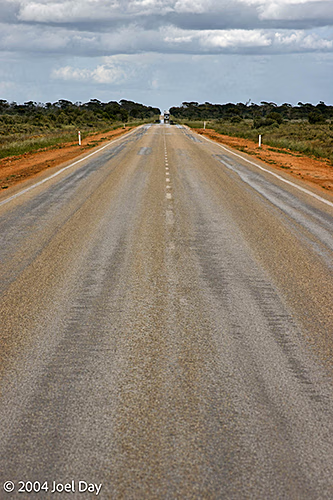
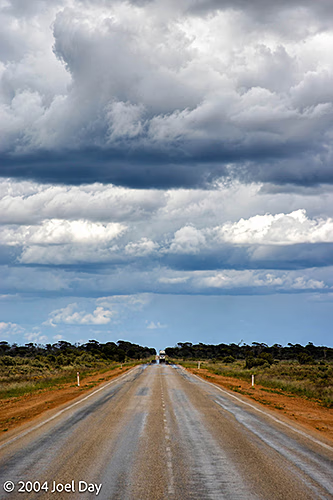
I try not to drive more that 4-5 hours a day, and preferably less (unless I’m really stuck in a boring area). It can be pretty stressful to drive for longer periods due to a variety of factors: The roads can be monotonous and boring which can be hypnotizing. They are not anything like the big smooth relaxing interstate highways in the U.S. They are bumpy and narrow and there is nothing separating your lane from the oncoming traffic lane (at 110 kph).

Of course, there rarely is any oncoming traffic — so you don’t have to worry too much about that. In fact, there are so few people driving on these roads that when you do stumble across someone travelling in the opposite direction it is common practice to wave. It pretty funny, actually. The locals do it, and then all the tourists pick it up and start doing it. The only problem is when you’re driving against most of the traffic. Then you’re seeing cars who are expecting you to wave back at them every few minutes because you’re the first car they’ve seen in the past hour.

The heat is another factor and it can make you feel sleepy. I alternate between using my air conditioner periodically and rolling the window down periodically. I don’t want to use the air conditioner too much because it really adds to the already expensive fuel costs. The further north I travel, the more this becomes an issue.

And then there is the wildlife factor — especially around sunrise and sunset, as well as the livestock factor. Like deer in North American, kangaroos are most active during twilight. I must have seen about 25 of them hoping across the road at various places on my drive up to Broome from 80 Mile Beach this morning. Big ones, little ones, and tiny ones I thought could have been rats if they weren’t hopping. I’ve also seen the odd emus darting across the street. Wildlife may be erratic, but at least you can predict when they’ll be a problem. You see plenty of dead animals along the road, but you can assume they were all hit at night. The solution? Don’t travel at night or during twilight.

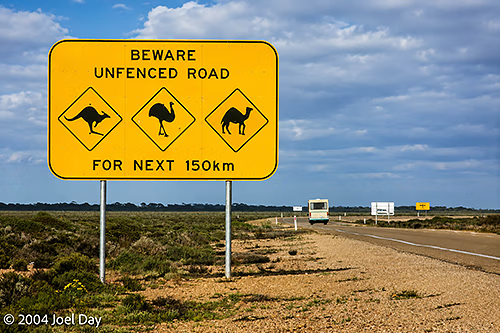
Livestock, on the other hand, seem to be out all day. Yes, there are no fences keeping large beef cattle and sheep off the road along many of Australia’s outback highways. I’ve actually seen a couple of huge cows rotting away about 50 feet from the road. Eyes open, legs up. Straight out of Monty Python. I can only imagine they were hit by large road trains (consisting of large trucks with 3-4 trailers, 52 meters long) which don’t stop for anything and drive all day and night. At least with livestock, they seem to move a lot slower and more predictably than wildlife. In either case, my eyes are always scanning the horizon for any animals and I always drop my speed way down when I spot them.

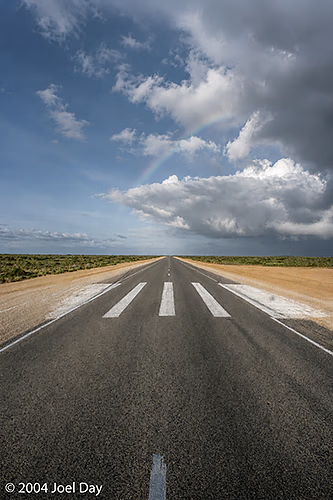
There have been a few other interesting things along the roadway. At one point I saw a little yellow sign stating that the road I was travelling on doubled as an emergency runway for the Royal Flying Doctors Service. I suddenly noticed the road widen and there were actually landing stripes across it to designate where planes should touch down on the ground. It was really odd to suddenly find yourself driving down the middle of a airport runway!

My only other road story would be the short cut I tried to take into Tom Price. It was a dirt road, which looked to be in pretty good shape. It was 70 km long but looked smooth, so I thought I would give it a shot to save some fuel on the alternative 150 km way. I travelled pleasantly along for about 20 kms and then I noticed the condition of the road start to rapidly deteriorate and get very bumpy. They have something they like to refer to as “corrugated roads” here that are just like what they sound like. Before long I noticed that there were actually car parts lying alongside the roadway. It was like a car part graveyard. To make a long story short, my little car finally made it into Tom Price and I vowed to never take any dirt roads again. Not for any serious length, anyway. I have to make sure my car can make it back to Perth.

So my usual strategy for finding decent places to camp in popular areas is to be there asking around 10AM. This is when most campgrounds have their checkout time and have the most places available. The worst thing you can do is drive all day and roll into town at 5PM looking for a spot. I made that mistake in Coral Bay and learned to get into towns much earlier. In order to get into a place by 10AM, I usually camp just outside the place I want to visit that I know will be popular. It’s been working well ever since I left Coral Bay.

Australia, Western Australia

Beautiful Broome

Bet you weren’t expecting another entry so fast! Neither was I, but I ended up here in Broome a little quicker than I expected. I tried to stay at the station listed in Lonely Planet but they had a big sign up on the main road saying they were forced to close to the public. Instead I camped across some dunes from 80 Mile Beach, which was quite spectacular. In fact, it’s 80 miles long (supposably), nice and wide with a very gradual slope into the ocean, which had beautiful azure waters. Only problem is that they advised against swimming — which didn’t leave much else to do around there. I took a long hike up the beach yesterday afternoon and kept running into 4WDs using it as a highway. Looked kind of fun, actually.

Broome seems huge compared to the other places I’ve been visiting. Most towns consist of nothing more that a handful of little shops, but Broome seems like Grand Central Station with all the tourists around. I’ve been warned repeatedly that it would be extremely expensive and I will have to get out of town quickly — but lo’ and behold, I found a camping spot on the town beach for $11 a night. It’s very nice. I will have to see if there are any surprises with it over the next 24 hours. If not, I may extend my stay. And to think others are spending $400 a night here…

Broome is an old pearling port that was once run primarily by Japanese investors up until WWII (if memory serves me correct). It was in the middle of nowhere until Lord McAlpine got stuck here in transit and fell in love with the place. He built a huge expensive resort (The Cable Beach Club) and now it’s overrun with tourists (at this time of the year, anyway) with directly flights from Sydney, Melbourne, and Perth (and probably Asia) dragging people in from all over. Broome has a reputation for being very multicultural. It even has a Japanese graveyard and a Chinatown that is supposed to have really good Chinese food.

I will post more about Broome after I get a chance to explore a little more…

Australia, Western Australia

If only there was mental telepathy…

Yes, this blog would be a lot easier to update through mental telepathy. I will have to look into it… As it stands, it is very difficult to update as I travel through some very remote regions here in northwestern Australia. I haven’t seen a traffic light since I left Perth. Many of the places I’ve been camping have no electricity or fresh water. Internet connections seem few and far between. My regular bedtime has been around 7PM every night since there is nothing much else to do after the sun sets and the temperature drops. That being said, the past ten days or so have been fabulous. I’ve been camping for about 12 straight days now and loving it. I sleep really well with all the fresh air.

Thankfully the long boring drive ended in Ocean Reef, and a really beautiful drive started from there up into Exmouth, and then back south and east up into the Pilbara area to the town of Tom Price and Karijini National Park. I can’t say that I was super impressed with Ocean Reef — mainly because it seemed a bit too crowded, over-priced, and expensive. A happy paradise for yuppies, it seemed. The snorkelling was pretty good, but I’ve had better snorkelling on Rottnest Island near Perth.

I went from Coral Bay up to the very northwestern tip of Australia to Exmouth. I ended up camping on a station just outside of the Cape Ranges National Park (since I couldn’t get into a camp ground in the national park during this peak tourist season up here). Exmouth was much warmer that Coral Bay (for some reason, even though it’s really not that far away) and it is full of exotic bird and other wildlife. The park was really nice with gorges you could hike up into during the mornings, and absolutely fantastic snorkelling you could dive into in the warmer afternoons. There were hundreds of species of beautiful big, medium, and tiny fish there, right off the beach. They seemed perfectly comfortable with you swimming amongst them. It was like swimming in some big rich exotic aquarium.

From Exmouth I drove to Tom Price, which was absolutely beautiful. Tom Price (named after an American, incidentally) is a big wealthy mining town in the middle of the Hammersley Ranges. The movie “Japanese Story” was filmed there if you want to check it out. It was about as beautiful a landscape as I’ve ever seen, with dark red soil, white barked trees, and Spinifex grasses that made the mountains look like they had been dusted with light green snow. An absolutely exquisite landscape.

Near Tom Price is a fabulous national park called Karijini that has a similar landscape, but with deep gorges that drop 100 meters into fabulous swimming holes. There were lots of great hiking trails throughout this whole area. The only problem with it was the fine red dust (much like paprika) that got into everything.

Anyway, I’m now in Australia’s largest port (by tonnage): Port Hedland. This is where much of Australia’s mined minerals from the interior get loaded onto boats for Asia. Asside from that, it’s nothing much to write home about. I’m about to head off towards Broome. I like camping on stations and will try to stop at another station on the way there to break up the 500 km trip. There are also supposed to be some nice beach camp sites along the way. Broome is supposed to be very nice, but I’m afraid it may end up as another Coral Bay. Nice if you’re rich!