Another interesting thing to note about driving around these parts is all the different agricultural regions and their strict quarantine requirements. It can be very tricky to stock up on fruit and veggies because every few hundred kilometres, you find you have to throw out what you’ve bought. Now that I’m thoroughly ensconced in New South Wales, I should be safe for the next few days before I get to Queensland – where I’m sure I will have to go through the same process again.
Murray River Meandering through agricultural regions in South Australia.
Much of the agriculture relies on the Murray River for irrigation. This area is where Australia seems to get most of its produce, although Western Australia seems to try growing most of its own. Prices for produce do seem a lot lower around here, anyway.
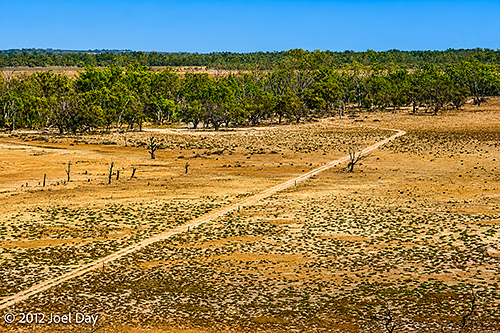
Farmland in need of water next to the Murray River.
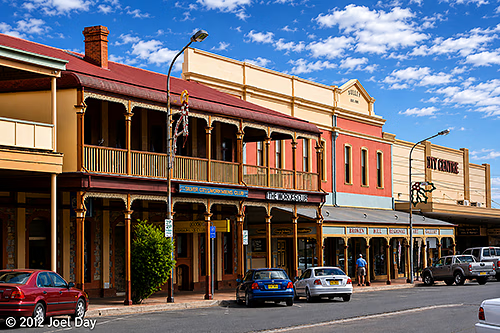
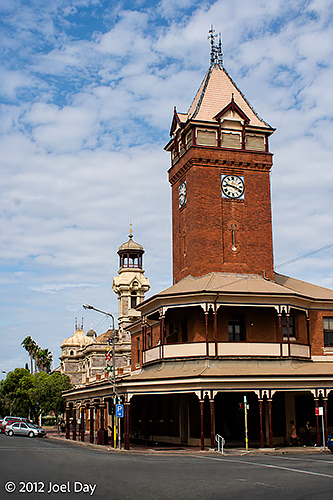
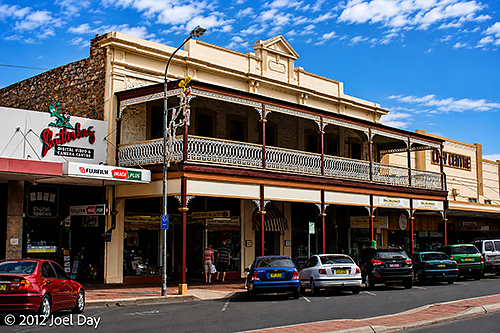
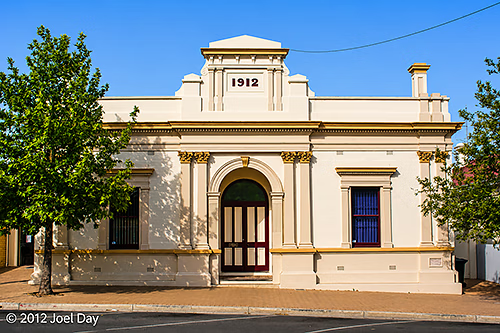
The small towns on this side of the country seem a bit more vibrant than they do in the west. Rather than spending time in big cities, small towns are often great to visit. No parking hassles with no meters. Everything you need is within easy walking distance. Surprisingly, the food can be really quite good if you seek out the right places. Broken Hill, New South Wales, appears to be a sister city to Kalgoorlie. Lots of nice old buildings, friendly libraries with free WiFi, and cool little cafes with trendy-looking people – perhaps displaced from the larger cities. Had some wonderful French toast for breakfast this morning. Also had some nice pizza from a town in South Australia called Loxton. Some day soon, I will break out the Trangia and cook my own dinner.
Broken Hill, New South WalesBroken Hill, New South WalesBroken Hill, New South Wales
Loxton was very small and had its share of people you’d expect to find in Dunt, South Australia. Loxton also had nice old buildings and everything you needed within a short walking distance of the town square.
Spent the night near Broken Hill in Kinchega National Park in New South Wales last night sleeping all by myself along the Darling River – with no other campers in the park. It was a beautiful park, full of a wide variety of wildlife. I saw countless kangaroos, including BIG grey ones I’d never seen before, that would make extra-big jumps when hopping away from you in your car – perhaps trying to intimidate you with their powerful rear legs. I also saw countless emus, smaller-than-usual-looking monitor lizards, strange black, chicken-like birds that preferred to run rather than fly, and heard lots of strange, loud noises at night – especially when sleeping along the river. All the animals seem to rely on the river to drink in the evenings, so it is amazing what you will see and hear there. Lots of big fish lurking underneath as well.
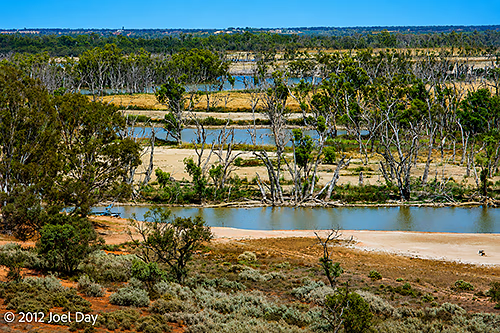
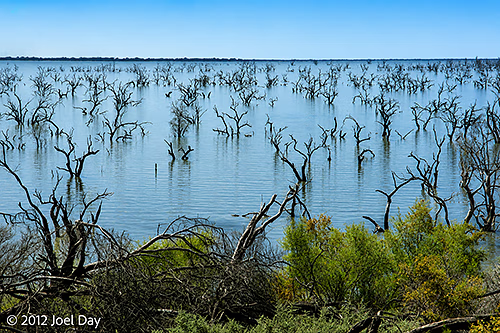
Lake Menindee in Kinchega National Park, near Broken Hill, New South Wales
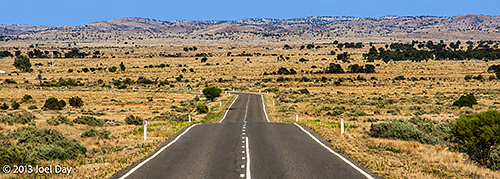
I tried taking a shortcut up from Mildura, Victoria (nothing to write home about), on my way here and found some of the worst dirt roads I have ever had to negotiate. The roads inside the national park were not much better. But then I remembered that it was just a little less than a year ago that this entire region was hit by massive floods:
Where I pitched my tent was about 2 meters below the flood lines on the trees in the area. The roads had obviously all been submerged and washed out at the time, so it is probably a miracle that they are in as good a state as they are at the moment.
Unfortunately for me, it was one of the very hottest nights I’ve ever had camping. I set up just my tent with no fly, and it still took forever to cool off! I tried to do like the animals and go for a swim, but the bank was so steep and muddy that I could only wade in about a foot to splash myself. Venturing any further in would sink my legs into very deep, endless clay, so I thought it best to stick to the shoreline.
I would have liked to have spent more time there, but the heat was a bit much to deal with. Should cool off in the next few days…
Interesting to compare my drive this time with the drive I did last time in 2004. Now I’m driving an SUV, which uses a bit more fuel than my little Corolla did. I seem to be carrying MUCH more stuff than I did last time, which is a bit of a pain. Among the items is my mountain bike, which has stayed in the back the entire time so far for various reasons (including security, fuel economy, and nasty road surfaces).
I have the aid of numerous GPS devices, but as far as navigation is concerned, they are really only best for micro views of where you are going and are a bit cumbersome to step back and get the big picture of where you are going for the day. Map books still lead the way in getting big-picture views of what is around. On the other hand, the GPS has been very good for sussing out all the service station options in small towns (where I have saved quite a bit tracking down the stations the locals use on back streets). They are also good for finding accommodation, shops, libraries, and other things.
It’s also been nice to have 4WD capabilities for some of the roads I’ve been on, and very nice to have cruise control. MP3 player as well? I actually had one of those installed in my little Corolla the last time I did a long road trip. Lots of hi-tech stuff, including my laptop – which makes it much easier to get photos on these blog posts! Most libraries I’ve found have free WiFi available these days.
Lots of fun with time changes on this trip. Along the train ride over east there was a special time zone called “train time” which was 1 hour earlier than Perth. Then you arrived in Adelaide and the time was 1/2 hour earlier still. Then I drive a relatively short distance to Victoria and the time moves another 1/2 hour forward to equal Melbourne and Sydney time. It stays that way up until I camp in Kinchega National Park in New South Wales, but when I double back briefly to visit Broken Hill the timezone changes again back to Adelaide time (or so say the road signs). When I eventually get up into Queensland the time will go back an hour from Sydney and Melbourne time. That means Brisbane is 1 hour later in time than Sydney and Melbourne, even though it is well east of them:
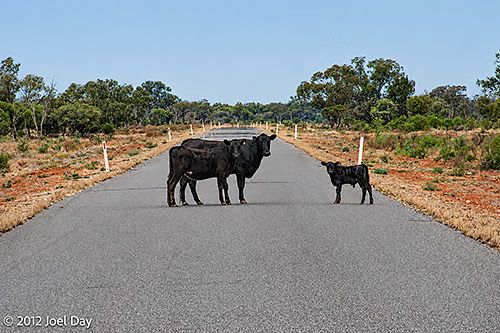
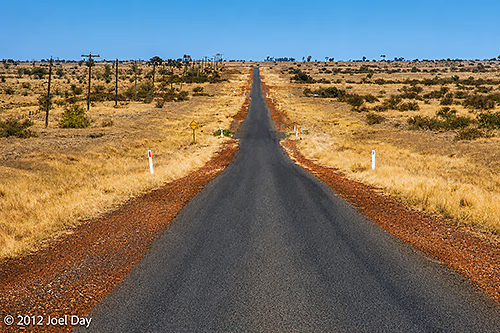
So far, my record of actually following my itinerary accommodation plans has been quite poor. This has largely been due to the heat – with temperatures hovering around +100ºF/+38ºC for over 12 days straight! Some national parks have proved to be very dry, extremely hot, and so desolate that I have been skipping them in favour of cooler surroundings. Forest Den National Park, for example, had neither a den nor a forest. It was essentially a ranch full of cattle with a campground 10km down a 4WD track that was just a patch of dirt next to a watering hole in 100ºF heat. I sat there for 5 minutes in the heat before deciding to move on. The cows even seemed a bit hostile towards me in my car on the way out, running up to block my exit and chasing me out. Don’t know what they would have been like in the middle of the night!
Other parks I visited but skipped were Gundabooka National Park, NSW (also very hot and isolated with claims of video surveillance even though there was no electricity around for miles – but the security problem issue was duly noted), Currawinya National Park, QLD (way too isolated and hot), Moorrinya National Park, QLD (another cattle farm?), and White Mountains National Park, QLD (no mountains I could see, but perhaps a few hills and a very hot and remote campsite down a 4wd track).
On the other hand, there were a number of national parks I had not anticipated visiting that I was able to get into at the last minute without any problems – so I am very happy things worked out the way they have.
You must be logged in to post a comment.