On my last full day in Pokhara, thick haze returned and blocked most views of the Himalayas, so I decided to check out the International Mountain Museum. Getting there became the usual drama in places like this. All you want is a simple taxi ride to the museum, and everyone’s eyes light up like it’s a potential sales opportunity for a day-long chauffeur job. It makes you think twice before going anywhere that requires a cab!
None of the cab drivers around here wants to use their meters, so you need to negotiate a price before you get in. Then, on the way there, they try to entice you to see all the sights around town you haven’t been to yet. Then they insist on a round-trip fare and say they will wait for you while you see the museum. “Half hour?” they ask. “Um, actually, how about 2 hours. I like to take my time.” I read the museum was quite large. They look at you like you’re crazy, and I’m sure the financial appeal of the deal suddenly doesn’t sound so good. I send him off, telling him to come back in 2 hours and not wait so he has the opportunity to earn from others, but I’m not sure he ever left.
Anyway, the museum was quite interesting, and it took me a few hours to get through it. There was information on each of the world’s 20 highest peaks (even more interesting after hiking past some of them) and who first climbed them. There was information on all the local plants and animals of Nepal, as well as the Yeti(!) The museum also had gear donated that had been used to reach some of the summits. It was interesting to see how rudimentary some of it was by today’s standards. Most of the gear seemed to have been donated by Asian expeditions, not from the West. There were also displays on each of the native groups prominent in different regions of the country, like the Sherpas of the Everest area.
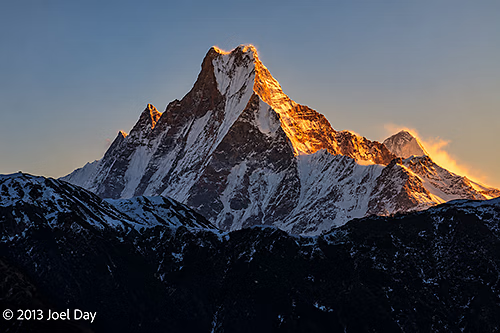
It seemed as though the 1950’s were the big years to conquer all the summits. One peak in Nepal has still never been successfully climbed, but the Nepalese government stopped allowing attempts in 1963. It’s called Machapuchare (also known as Fishtail Mountain, named for its twin peaks that look like a fishtail), with an elevation of 6,993 meters. It is very steep and difficult to ascend.
One of the most interesting displays was of all the garbage they have cleaned up from Mount Everest. One climber who eventually made it to the top was so dismayed by all the things left by previous climbers that he organised a regular cleaning campaign to collect the waste and fly it out. Among the debris were pieces of broken ladders (used to get across crevices in the ice), big piles of cooking stove gas canisters (some flattened by ice pressure over time), old ripped-up tent fragments, and big piles of oxygen tanks – some dating back to the 1960s.
