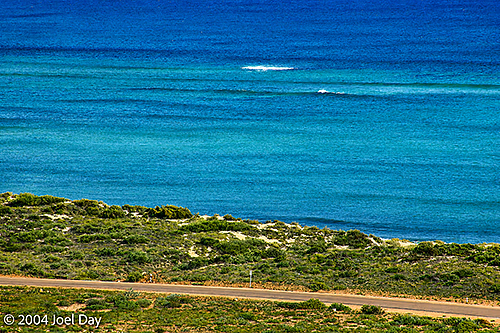
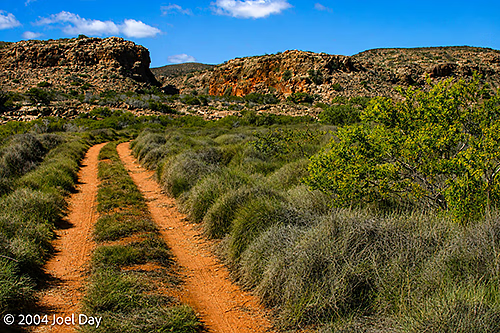
So I bet you’re all curious about the drive… It seems far more interesting when you venture away from the flat coastal scrub along the edges of Australia and head up into the interior. I will have a chance to drive through another beautiful area when I venture into The Kimberly after leaving Broome during the next week, but to date it’s been a lot of boring driving.
So yes, I’ve logged about 5 or 6 thousand kilometres so far. I can’t remember the exact figure, but it’s somewhere around there. I keep myself company while driving by listening to my CD collection. I invested in an MP3 player for my car a few months back and ripped all my 300-400 CDs onto about 25 disks that fit nicely into a single CD wallet. It’s pretty cool to squeeze 15 CDs onto one MP3 CD. You can’t hear the difference in sound quality on most car stereos.
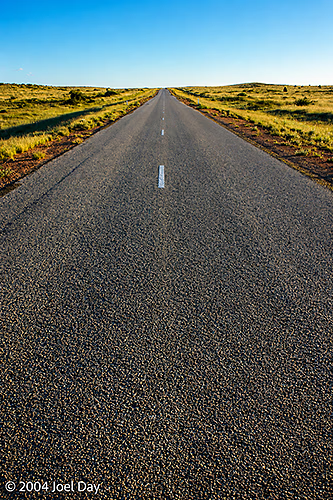
I try not to drive more than 4-5 hours a day, and preferably less (unless I’m really stuck in a boring area). It can be pretty stressful to drive for long periods due to a variety of factors: the roads can be monotonous and hypnotic. They are nothing like the big, smooth, relaxing interstate highways in the U.S. They are bumpy and narrow, and there is nothing separating your lane from the oncoming traffic lane (at 110 kph).
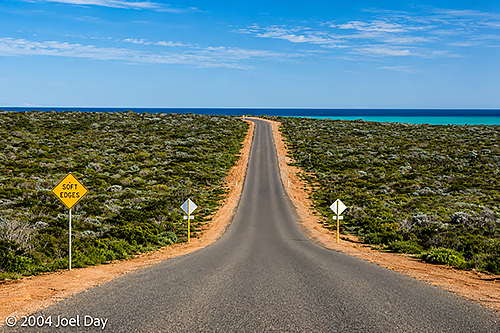
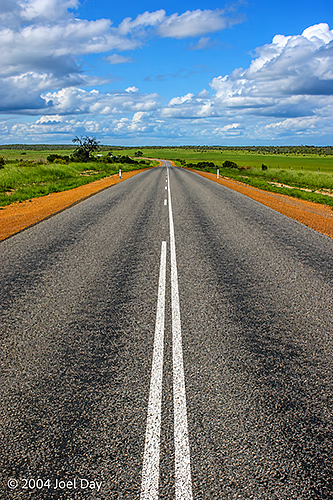
Of course, there rarely is any oncoming traffic — so you don’t have to worry too much about that. In fact, there are so few people driving on these roads that when you do stumble across someone travelling in the opposite direction, it is common practice to wave. It’s pretty funny, actually. The locals do it, and then all the tourists pick it up and start doing it. The only problem is when you’re driving against most of the traffic. Then you’re seeing cars expecting you to wave back every few minutes because you’re the first car they’ve seen in the past hour.
The heat is another factor, and it can make you feel sleepy. I alternate between using my air conditioner periodically and rolling the window down periodically. I don’t want to use the air conditioner too much because it really adds to the already expensive fuel costs. The further north I travel, the more this becomes an issue.
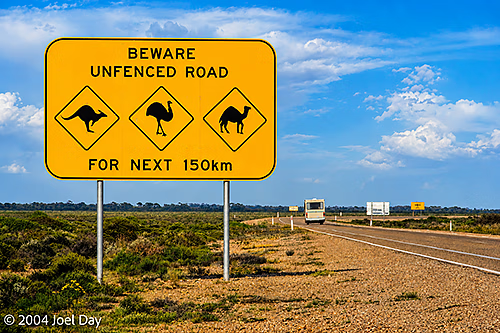
And then there are the wildlife and livestock factors — especially around sunrise and sunset. Like deer in North America, kangaroos are most active during twilight. I must have seen about 25 of them hopping across the road at various places on my drive up to Broome from 80 Mile Beach this morning. Big ones, little ones, and tiny ones, I thought could have been rats if they weren’t hopping. I’ve also seen the odd emus darting across the street. Wildlife may be erratic, but at least you can predict when they’ll be a problem. You see plenty of dead animals along the road, but you can assume they were all hit at night. The solution? Don’t travel at night or during twilight.
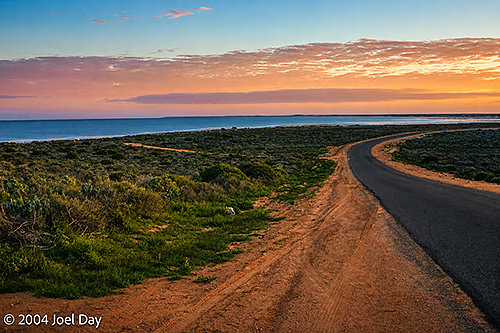
Livestock, on the other hand, seem to be out all day. Yes, there are no fences keeping large beef cattle and sheep off the road along many of Australia’s outback highways. I’ve actually seen a couple of huge cows rotting away about 50 feet from the road. Eyes open, legs up. Straight out of Monty Python. I can only imagine they were hit by large road trains (consisting of large trucks with 3-4 trailers, 52 meters long) which don’t stop for anything and drive all day and night. At least with livestock, they seem to move a lot slower and more predictably than wildlife. In either case, my eyes are always scanning the horizon for any animals and I always drop my speed way down when I spot them.
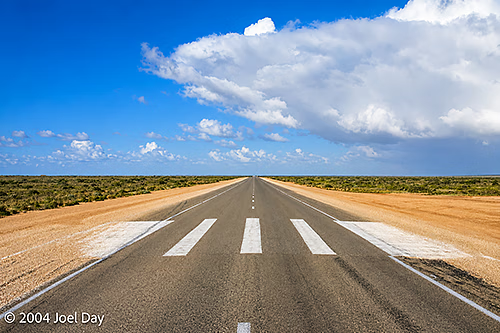
There have been a few other interesting things along the roadway. At one point, I saw a little yellow sign stating that the road I was travelling on doubled as an emergency runway for the Royal Flying Doctors Service. I suddenly noticed the road had widened, and there were actually landing stripes across it to mark where planes should touch down. It was really odd to suddenly find yourself driving down the middle of an airport runway!
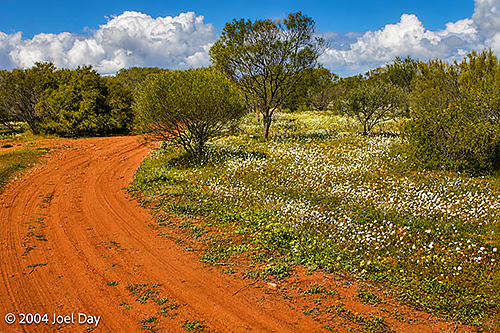
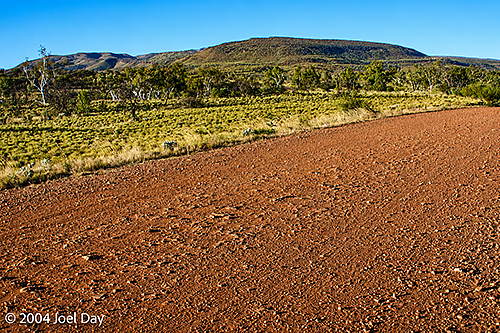
My only other road story would be the shortcut I tried to take into Tom Price. It was a dirt road, which looked to be in pretty good shape. It was 70 km long but looked smooth, so I thought I would give it a shot to save some fuel on the alternative 150 km way. I travelled pleasantly along for about 20 kms, and then I noticed the condition of the road started to rapidly deteriorate and get very bumpy. They have something they like to refer to as “corrugated roads” here that are just like what they sound like. Before long, I noticed that there were actually car parts lying alongside the roadway. It was like a car part graveyard. To make a long story short, my little car finally made it into Tom Price, and I vowed to never take any dirt roads again. Not for any serious length, anyway. I have to make sure my car can make it back to Perth.
So my usual strategy for finding decent places to camp in popular areas is to be there asking around 10AM. This is when most campgrounds have their checkout time and have the most places available. The worst thing you can do is drive all day and roll into town at 5PM looking for a spot. I made that mistake in Coral Bay and learned to get into towns much earlier. In order to get into a place by 10AM, I usually camp just outside the place I want to visit that I know will be popular. It’s been working well ever since I left Coral Bay.


You must be logged in to post a comment.