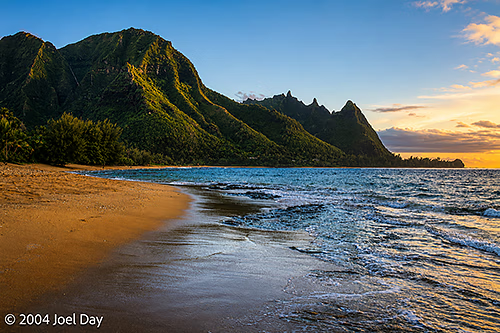
After spending a week on Hawaii’s newest island, I hopped a flight from Hilo to Lihue on Hawaii’s oldest and westernmost (inhabited) island: Kauai. Kauai is known as “The Garden Island” for its lush greenery, but all I saw for my first few days there was traffic. Kauai is just a fraction of the size of The Big Island with a population of only 58,000, so there aren’t as many places for tourists to spread out. Basically, there is just one major road that doesn’t even go all the way around the island, and everybody seems to be driving on it. It’s also the wettest place on earth, so there is lots of rain to contend with.
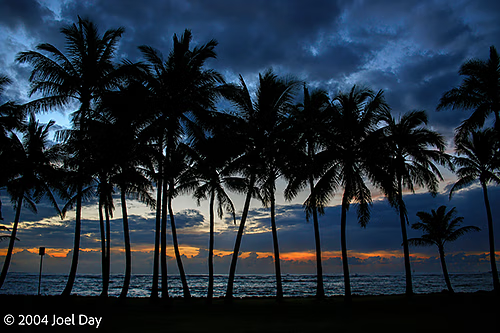
I decided to head up to the town of Kapaʻa on the east coast as soon as I hit the ground. Although halfway up the island on a map, it was actually only 8 miles from Lihue (where I landed), the biggest town on the island. I found a groovy beach house hostel overlooking the ocean in Kapaʻa. I later realised it was the only hostel worth staying at on the whole island.
On the one hand, the laid-back hostel owner, a purported chiropractor (who never seemed to see any clients), had done a nice job setting the hostel up with mosquito nets and drapes around each bed for privacy. There was a nice constant sea breeze flowing through the premises to cool things down in the evening. On the downside, it quickly became apparent that most of the tenants were long-term.
Most of the hostels I visited in Hawaii seemed deserted, perhaps because of restrictions on how long a visitor could stay. I witnessed two people being kicked out of a HI hostel in Honolulu for overstaying their welcome. This one hostel in Kapaʻa was about half full, but most of the tenants seemed to have had menial jobs in the area and old clunker cars parked out back. They had no real ambition other than to live in Hawaii. The showers were full of old half-used shampoo bottles, just like you would expect to find in someone’s private bathroom. These are the kinds of things you wouldn’t find in most hostels. And the long-term tenants seemed a bit flaky, too. You would ask someone why he or she chose to live on a particular island, and they would respond with phrases like, “I didn’t choose this island. It chose me!”
The problem I find with allowing long-term tenants is they’re not interested in what they perceive as transient tenants, like myself. They’re only interested in networking with other mainlanders who share the same lame ambitions as they do. The whole fun of staying in hostels is meeting other travellers from around the world with similar interests and comparing notes on what’s worth seeing and what’s worth skipping. This policy of allowing long-term tenants made my stay at this hostel somewhat awkward after a few days.
One thing I found different about backpacking around Hawaii was the tourists. Where in most countries you would find about half local tourists, lots of other people from all over the world, and a smattering of American visitors, Hawaii seemed to be 99% Americans and hardly anyone else. And while most Americans seemed to end up at resorts as part of package deals, the low-budget places were full not of tourists but of mainlanders trying to make a go of it in Hawaii.
